BOOTING CONSOLEreading pipeline state
EYE OF HORUS
onchain market intelligence
It watches a chain.
Then it scores itself in public.
Eye of Horus decodes every swap on a chain into its own price archive and runs measured rules over it. Every call it makes is followed to an exit and published — win or lose, the whole book, with the count beside the number.
It is a signal source, not a trading system. It never signs a transaction, never holds a key, and never tells anyone what to buy. What it does is keep a record you can check.
- Calls scored
- 535
- closed, counted, published
- Days on record
- 75
- since 2026-08-18
- Hit rate
- 44%
- 237 of 535
- Last call of the day
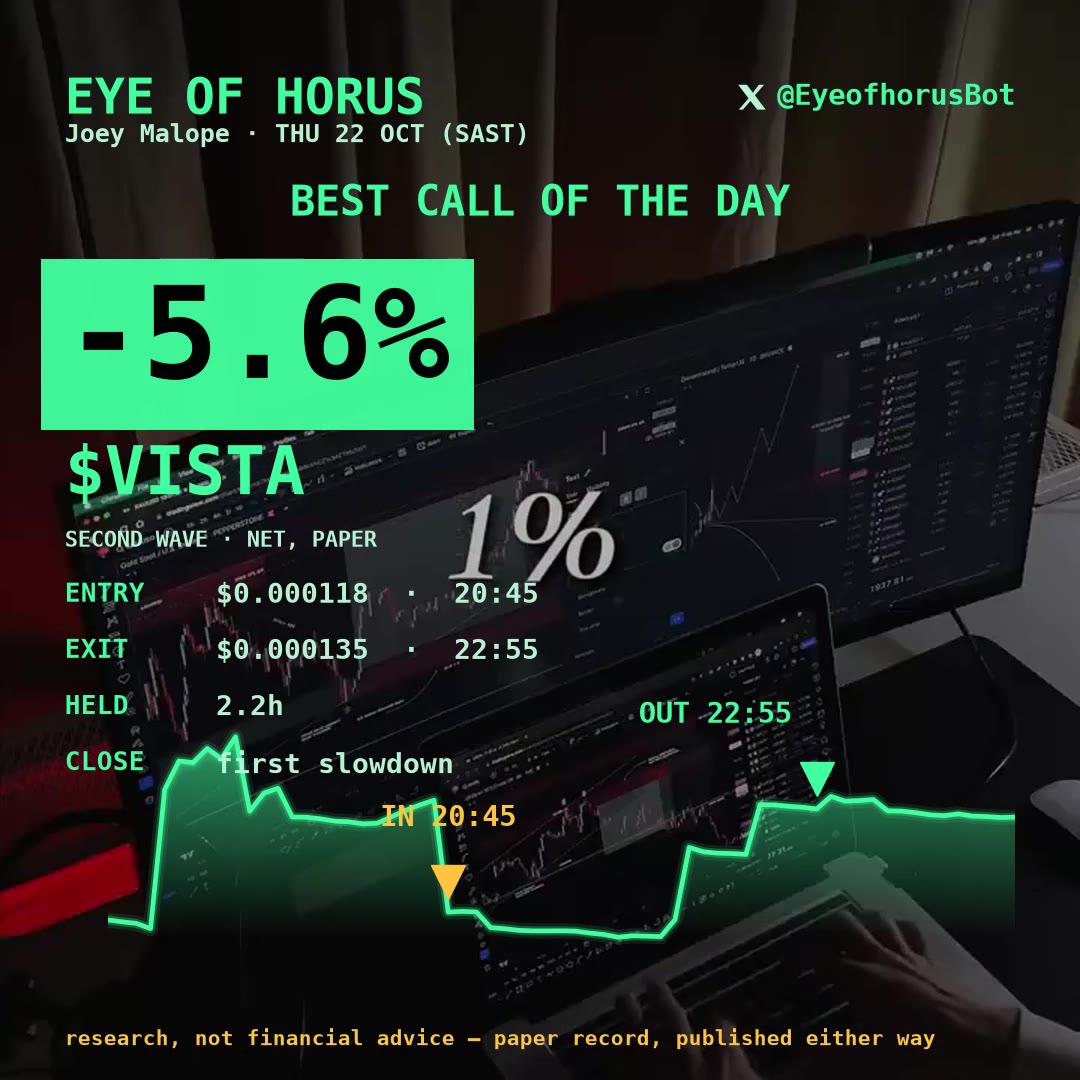
- VISTA −5.6%
- 2026-10-22
The reels
closed trades onlyEvery video this system has published, newest first: the best closed trade of a day, the day book itself — every close in the window, wins and losses, with the worst one named on the card — and the weekly discovery card, which is what the scanner spotted rather than anything traded, and is labelled as such. Entry prices appear retroactively, where nobody can act on them and anybody can check them. A red day publishes the same way; a record that hides its losers is an advertisement.
The record
every figure with its denominatorSecond Wave, since the book started closing trades — every close it made, not a selection of its good days. The scanner that finds candidates is not a trading rule and is not scored as one; what it costs to leave out is counted below the table.
Second Wave
Queues a correction and buys the stabilisation. The rule that trades, and the only one scored here.
−733.4%
summed across 535 closes · −1.37% each
- Hit rate
- 44%
- 237 of 535
- Window
- 08-18 → 10-30
- 2026
- Best close
- +353.5%
- single trade
- Worst close
- −97.2%
- single trade
- ! This is a paper record. The system produces signals; it never signs a transaction and never holds a key, so these are the results of the rules, not of an account.
- Every % is net of an assumed 2% slippage and 0.3% fee on each side — the same arithmetic the console and the reels use, so no two surfaces can disagree.
- Open positions are not on this page. Winners exit first, so the open book is the residue and skews red by construction — publishing it would misreport the day and put a live, unscored claim in public.
- 3231 further closes belong to the discovery scanner — the rule that finds candidates. It is not a trading strategy, so it is not scored here; counting it as one would be a number nobody could read correctly.
- 33 of the earliest closes predate strategy labelling and are excluded rather than folded in.
- A summed % is every trade's result added together. It grows just by trading more, which is why it never appears here without its count.
Method
chain-agnostic- 01WATCH
Enumerate every token on the chain.
Search endpoints cap out, so discovery reads the explorer directly. You cannot rank what you never saw.
- 02FILTER
Strip rugs, honeypots and dead tokens.
A rug is a present-tense condition — no liquidity, no volume, collapsed price today. Survival for a week is itself the evidence.
- 03RANK
Find what ran, then who traded it.
Tokens that multiplied are the study set. The wallets inside them are the candidates — not yet the answer.
- 04CORRECT
Divide by everything they ever traded.
Picked on outcome, every wallet looks brilliant. Hit rate over full history separates skill from spray-and-pray. This step decides signal or noise.
- 05SIGNAL
Alert only when independent wallets converge.
One wallet buying is noise. Several unrelated proven wallets buying the same new token inside a short window is the event worth knowing.
Where the line is
outcome public, rule privateWhat it will never do
- Never publishes a live entry
An open position is an actionable, unscored claim. Publishing one would front-run our own signal — so a call appears here only after it has closed, when nobody can act on it and anybody can check it.
- Never publishes the rule
The thresholds, the exit conditions and the wallet list stay private. What is public is the outcome and its denominator, which is the part you would need to judge us anyway.
- Never signs, never holds a key
It produces no orders and custodies nothing. There is no account here to lose.
- Never gives advice
Not as a hedge, not as a hint, not when asked directly. It is a signal source; the trade is always somebody else's decision.
- Never invents a number
If a measurement does not exist, the surface reads “—”. A missing price is never quietly replaced with today's.
What is always published
- Every call is followed to an exit
Green and red, at the same cadence and the same size on the page.
- Every figure carries its denominator
A hit rate without a base rate, or a summed % without its trade count, is a way of being wrong that this project has already been.
- The record is the whole book
Every close the strategy made is in the number — not a selection of its good days. What is left out is counted on the page, with the reason.
- Negative results are published
Rules measured to fail are reported as plainly as rules measured to work — five dead protective overlays, age predicting survival but not returns.
- Coverage is stated
A five-minute bar exists only if something traded. Where the history is thin, the number says so instead of averaging over the hole.
The daily close digest
One message a day: every trade the book closed, green and red, with the day's count and the running record beside it.
- ✓ Closes only. No entries, no live signals, nothing actionable.
- ✓ Losses at the same cadence as wins.
- ! Not sending yet — the email channel is still being built. This records your address and nothing else.